
Madison housing stock is a four-decade time-lapse. The East-Washington four-square with a porch swing and a coal-cellar-turned-laundry is 1908. The Mansion Hill brownstone row with cast-iron stair rails and 11-foot ceilings is 1890. The Vilas bungalow with the leaded-glass picture window is 1923. The Maple Bluff lake cottage with the screen porch over Lake Mendota is 1948. The Westmorland mid-century split-level off Mineral Point Road is 1962. Atwood Avenue ranch is 1955. Tenney-Lapham co-op flats over Williamson Street storefronts are 1925 with a 1972 partition. Each one has its own stair geometry, its own doorway clearance, its own basement-plate corrosion pattern from sixty winters of salt-grit melt-off, and Wisconsin MOOvers has loaded all of them.
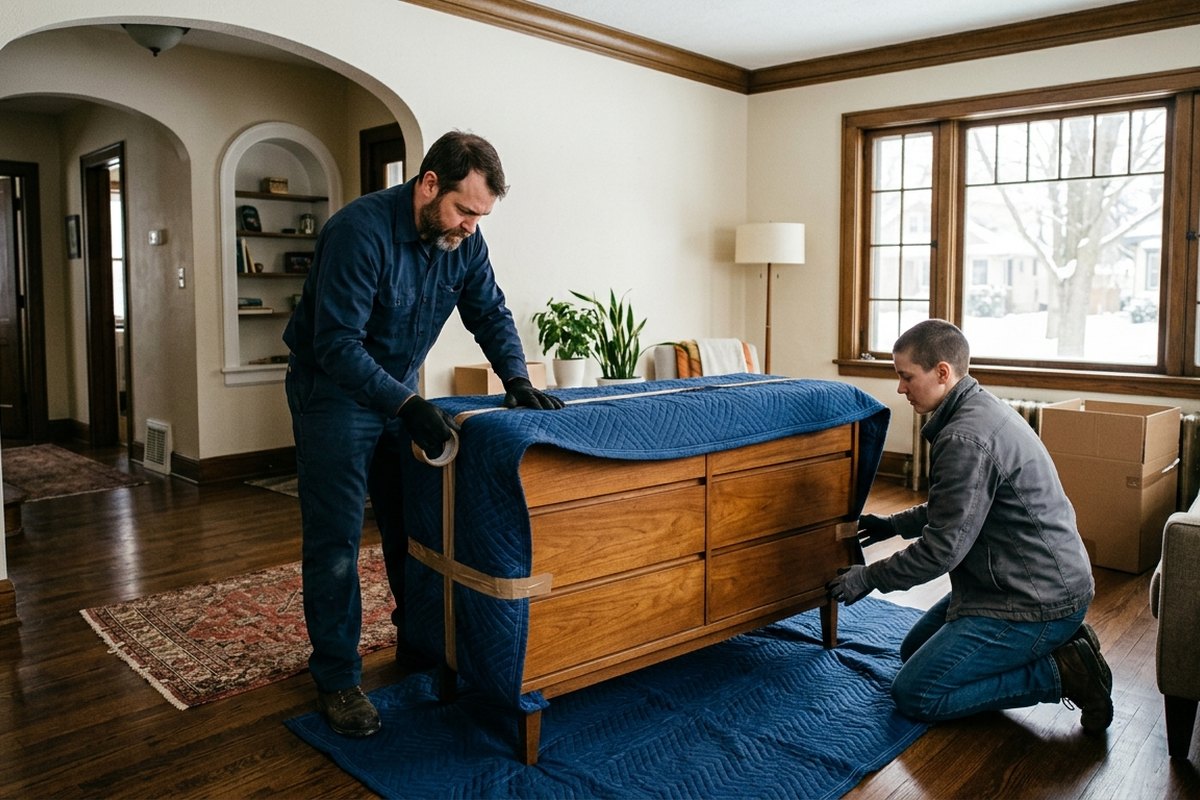
Residential rates run the standard $175 an hour with three movers and a truck for a one- or two-bedroom, or four movers and the larger box for three-bedroom and up. A binding flat from $565 holds for small in-town moves; larger whole-home jobs are written as a flat figure off Dustin’s walkthrough and capped — the cap doesn’t move on move-day. $225 deposit secures the date. What changes across the housing stock is the equipment that rolls off the truck. Mansion Hill brownstones get the four-wheel piano dolly for the stair landings and a banister-pad rig on the cast iron. Maple Bluff lake-cottage moves get the wider quilted blankets because half the furniture is heirloom solid wood and half the doorways are 1948 narrow. Vilas bungalow basement carries get the threshold ramp because the back-yard steps drop eight inches.
And then there is the Wisconsin season layered over every job. Spring is mud-season — April carries get the rosin-paper floor runners doubled on hardwood because Atwood Avenue gravel turns to slurry the second the boots come back inside. July hands you 90-degree-plus humidity in a third-floor Tenney-Lapham co-op flat with no air conditioning, so the dispatch board pulls those carries to a 6 a.m. start and bottles water in the truck cab. November carries take rain pants and grip boots. January is the discipline test — the cab heat runs all night in the yard, frozen-ground anchor straps come off the rack, the heated load box stays at 50 degrees so the cedar chest doesn’t check. Lukas Bauer and his cousin Erik grew up loading these houses through every one of these seasons, and the truck inventory matches the calendar before the rig ever leaves Robertson Road.
What's Covered
- Equipment loaded against the actual housing stock — banister pads and four-wheel piano dollies for Mansion Hill cast-iron stair landings, threshold ramps for Vilas bungalow back-yard step drops, wider quilted blankets for the narrow 1948 Maple Bluff cottage doorways
- Three-mover crew on a $175 hourly figure for one- and two-bedrooms, four-mover crew on the larger box for three-bedroom and up; binding flat figure capped at the walkthrough number with no move-day overage
- April mud-season floor protection — rosin paper doubled on hardwood, runners stretched from porch to bedroom because Atwood Avenue gravel turns to slurry the moment the crew tracks it back inside
- Six a.m. summer-dispatch starts on Tenney-Lapham third-floor co-op flats and Williamson Street walk-ups so the crew is not loading furniture in 92-degree July humidity without air conditioning
- January heated-truck-box and yard-warmed cab discipline for solid-wood heirloom pieces — oak hutches, walnut headboards, cedar chests — that crack when the temperature swings from a sub-zero windchill to a 68-degree living room
- Same Lukas Bauer crew chief from the curb load to the destination unload on every Madison house, lake-cottage and East-Wash four-square — no afternoon shift handoff, no day-labor pickup at the new doorway
What's the Cost?
Two uniformed Akamai-crew W-2 movers plus the 26-ft straight truck post out of the Robertson Road gate at $175 an hour; for a studio, junior one-bedroom or a tight in-building lanai-to-lanai swap that slots cleanly into a half-day, Dustin will lock it as a flat figure instead, opening at $565 all-in.
Everything the day calls for is folded into that hourly figure: the two W-2 movers themselves, the 26-ft Wisconsin MOOvers truck, quilted blankets, masonite floor runners, two-wheel and four-wheel dollies, ratchet straps, walk-boards, and the January windchill mats we put down off the porch in any month with salt on the sidewalk. Fuel adders, third-floor stair charges, long-carry charges from the alley to the door — none of those line items show up on a Wisconsin MOOvers invoice, period.
Get My Quote